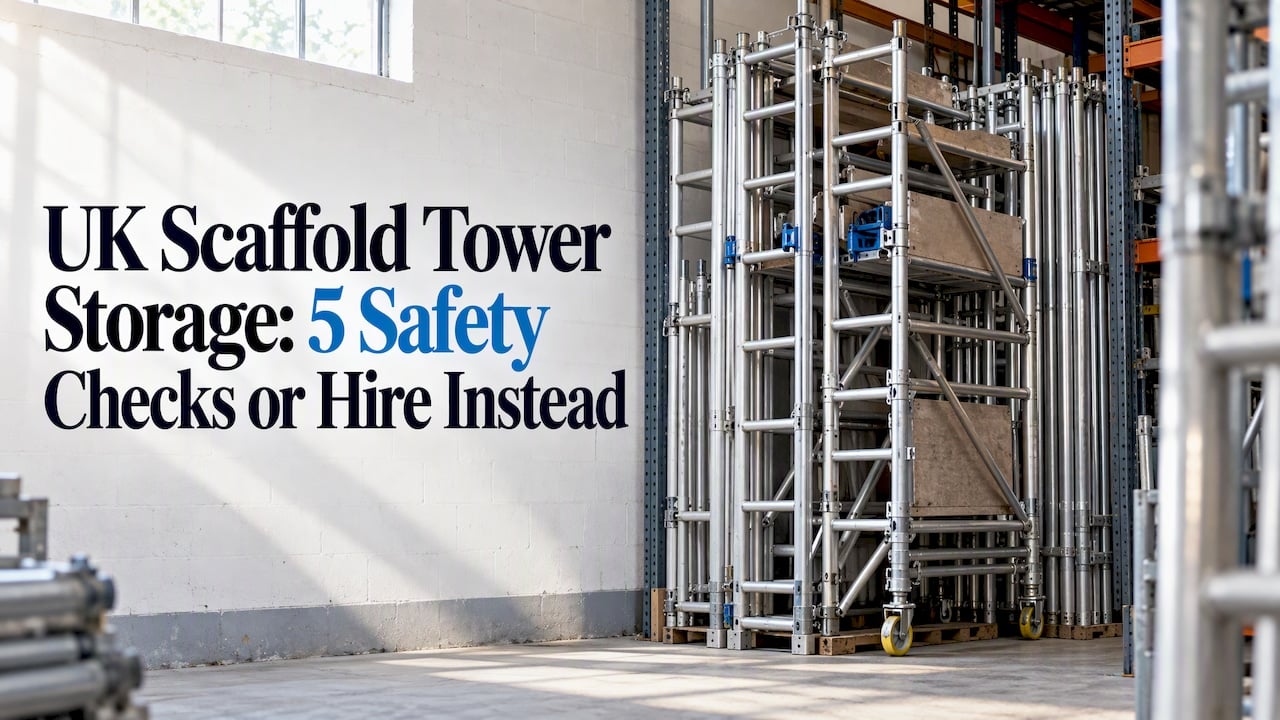
Dismantle to the manufacturer-permitted sections, clean every component, and stack it under cover on firm, level ground, following your manufacturer’s manual and HSE guidance at every stage. If you move it first, reduce it to no more than the maximum height allowed for moving as per your manual. When storage space or time is the real problem, hiring from a compliant supplier removes the issue entirely.
TL;DR:
- HSE caps assembled tower movement at 4 meters, subject to lower manufacturer limits; move from the base only after checking hazards and clearing the tower.
- After months in storage, inspect the full set again, test castors, hooks, and latches, and treat missing inspection records as grounds for a complete check.
- Quarantine damaged components and record each inspection; missing sections can compromise tower strength, so confirm every part is present before assembly.
- Use firm, level ground or load rated racking, keep components away from water and corrosive chemicals, and leave a clear access lane for handling.
Table of Contents
- Quick storage checklist: securing a tower after use
- Choosing a storage location and preparing the area
- Cleaning and inspection: before storage and before next use
- Stacking, banding and securing components safely
- Moving and transport rules you must follow
- Long-term storage and maintenance schedule
- Why hiring from a compliant supplier removes the storage burden
- How long can a scaffold tower sit in storage before it’s a problem
- Security measures to prevent theft or unauthorised access
- Space optimisation for storing towers in limited areas
- Environmental considerations: moisture and rust prevention
- Author perspective: the mistakes that keep showing up
- How we can help with hire instead of storage
- FAQ
- Sources
Quick storage checklist: securing a tower after use
Getting a tower off site and into storage safely takes a fixed order of steps, not a rushed strip-down.
- Reduce the tower to a safe moving height before any repositioning, following the limits in your manual.
- Dismantle to the sections your manufacturer permits for transport and storage, never larger assemblies.
- Clean each component and inspect it before it goes anywhere near a shelf or rack.
- Set aside any damaged part in a labelled quarantine box rather than storing it with usable stock.
- Stack frames on dunnage, band them, immobilise any castors, cover the set, and sign off the inventory against your records.
Each step protects the next one. Skipping the clean-and-inspect stage, for instance, means you store problems you will not notice until you are halfway up the tower on the next job.
Choosing a storage location and preparing the area
Where you put a dismantled tower matters almost as much as how you pack it. A damp corner or an uneven slab undoes careful stacking within weeks.
- Pick a sheltered, dry space: a garage, lock-up or covered yard beats an open compound every time.
- Store on firm, level ground or proper racking, never directly on soil or loose aggregate.
- Check the floor can take the load where you are stacking multiple frames several high.
- Keep the area away from corrosive chemicals, fuel stores and anywhere water can pool or run.
- Mark out a clear access lane so components can be lifted and carried without climbing over other stock.
A tidy, well-lit storage bay also makes the next inspection faster, because nothing is buried under unrelated kit.
Cleaning and inspection: before storage and before next use
Cleaning and checking a tower is not a formality. PASMA’s operator guidance treats it as the step that keeps aluminium towers safe and extends their working life, and the same checks apply again before the tower goes back into service.
- Remove concrete splashes, render and any corrosive residue, then dry components fully before stacking them.
- Check tubes for dents deeper than about 5mm, broken locking hooks, and seized or damaged castors.
- Keep a written record of what was checked, by whom, and what was set aside.
- Leave manuals and component lists with the stored set, not in a separate filing cabinet.
- Have inspections carried out by someone with recognised competence, under a scheme such as PASMA, as HSE’s work-at-height guidance expects.
Pro Tip: Photograph any damaged part before you quarantine it, so the next person handling the inventory knows exactly why it is set aside.
Stacking, banding and securing components safely
Loose, unsecured stacks are how towers get damaged in storage long before they ever reach a job site again. A clean stack is a stable one.
- Rest frames on dunnage or pallets rather than directly on the floor, to keep them dry and off any surface moisture.
- Band matching frames together so they cannot slide or topple if the stack is knocked.
- Store small fittings, clips and castor pins in labelled boxes rather than loose in a bin.
- Immobilise castors on any assembled sections left standing, using their built-in locks.
- Fence off or lock the storage area itself, particularly where stock is accessible to anyone passing through a yard.
Our scaffold tower access accessories page covers the kind of straps, castor locks and dunnage boards that make this stage straightforward.
Moving and transport rules you must follow
Moving a tower, even a short distance across a yard, carries its own rules and they are not optional. HSE guidance sets a maximum height of 4 metres when a tower is moved assembled, specifically to reduce the risk of it toppling.
- Reduce the tower to the manufacturer-specified maximum height for moving before pushing or pulling it anywhere.
- Push or pull from the base only, never by leaning on upper frames or guardrails.
- Check the ground ahead and overhead for obstructions, slopes, drains and power lines before you start.
- Never move a tower in windy conditions, or with people, tools or materials still on it.
- For longer transport, strap sections individually to vehicle racking rather than moving a tower assembled.
Larger towers should be broken down into their component sections for any road transport, with each piece secured separately rather than relying on straps across a loosely stacked load.
Long-term storage and maintenance schedule
A tower left in storage for months still needs attention, not just a cover. Build a simple calendar around it.
- Record a full inspection and inventory before the tower goes into long-term storage, not just after it comes out.
- Carry out a periodic check every few months while it sits unused, looking for corrosion, loose fittings or missing parts.
- Quarantine anything damaged the moment you spot it, rather than leaving it in the main stack.
- Apply light lubrication to moving parts such as castor bearings and locking pins to prevent them seizing.
- Keep manuals and component lists physically with the stored set so nobody has to search for them later.
Our scaffold tower hire checklist walks through the same inspection points in more depth if you want a reference to keep on file.
Why hiring from a compliant supplier removes the storage burden
Owning a tower means owning its storage problem indefinitely: the space, the periodic checks, the eventual repairs. Hiring sidesteps all of that.
- We supply towers with the manufacturer’s manual included, so configuration and height limits are never guesswork.
- Every tower goes out maintained and inspected, though you should still check it on site before first use, as HSE and PASMA both expect of any user.
- No-deposit hire and free next-day delivery mean you are not tying up capital or storage space between jobs.
- Over 250 tower sizes and types mean you hire the configuration a job actually needs, rather than storing a one-size compromise.
- When the job finishes, the tower goes back, not into a corner of your garage.
For many trades and homeowners, that trade-off, paying for use rather than owning and maintaining, is the simpler route.
How long can a scaffold tower sit in storage before it’s a problem
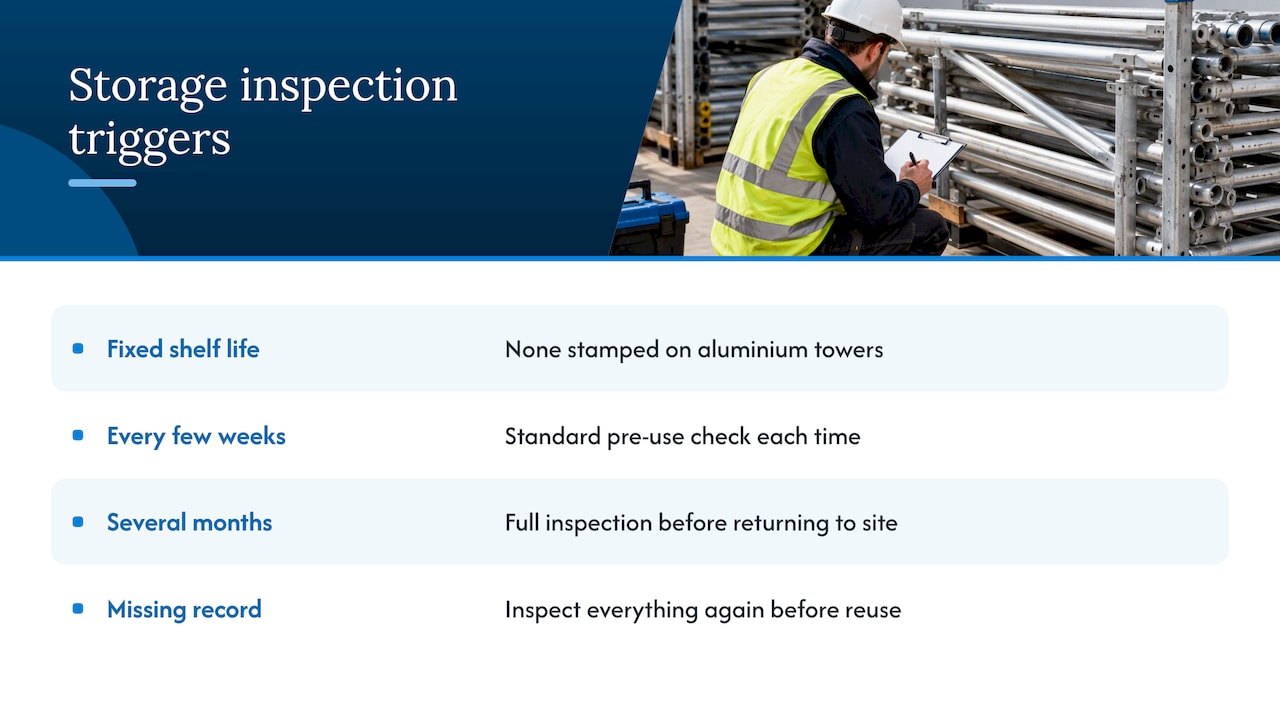
There is no fixed shelf life stamped on an aluminium tower, but prolonged storage changes what you need to check before trusting it again. The longer components sit idle, especially outdoors or in a damp building, the more time corrosion, seized fittings and unnoticed knocks have to accumulate.
PASMA’s operator guidance ties service life directly to how carefully components were cleaned, checked and stacked before they went into storage, not to a calendar date. A tower cleaned, dried and racked properly after every use will tolerate months of storage far better than one shoved away wet and dirty for a fortnight.
The practical rule is to treat storage duration as a trigger for inspection frequency rather than a hard limit. A tower in use every few weeks only needs the standard pre-use check each time. One that has sat for several months needs a fuller inspection before it goes back on site: castors exercised to confirm they still turn freely, locking hooks and trapdoor latches tested, and every tube checked again for the dents and damage PASMA’s assembly guidance flags as grounds for quarantine.
If a set has been stored for an extended period and nobody can produce the inspection record from before it went away, treat that gap itself as a reason to inspect everything again rather than assume it is fine.
Security measures to prevent theft or unauthorised access
Scaffold towers are valuable, portable, and often stored somewhere less secure than the main compound. That combination makes them a target.
Start with the basics: lock the gate or door to wherever the tower is stacked, and do not leave assembled sections standing in an open yard overnight. Castor locks, engaged whenever a tower is left even briefly, slow down anyone trying to wheel a section away. Chaining frames to a fixed point, or running a cable through banded stacks, adds a second barrier that a casual opportunist will not bother defeating.
Marking components, whether with paint, stamped identification or a tracked asset tag, does two jobs at once. It discourages theft because marked kit is harder to resell, and it helps you confirm a full inventory is still present after storage, which matters structurally as well as financially: HSE notes that towers rely on every section being in place for their strength, so a missing piece is not just a loss, it is a safety gap waiting to be filled with the wrong part.
Where towers are stored at a site rather than a secure yard, keeping them out of sight behind hoarding or inside a locked container reduces opportunistic access far more than a padlock on an otherwise open rack.
Space optimisation for storing towers in limited areas
Most storage problems are not about having nowhere to put a tower. They are about storing it inefficiently.
Vertical racking is the single biggest space saver: frames stacked flat on the floor take up far more footprint than the same frames racked on edge, supported on purpose-built shelving or simple scaffold tube racks. Banding matching frames together before racking also tightens up the stack, since loose components left to splay out waste space between them.
Breaking a tower down to its smallest permitted sections, rather than storing larger pre-assembled sub-units, lets you nest components more tightly and use awkward corners of a store that a bulky half-built frame never would. Small fittings, pins, clips and castors belong in stackable, labelled boxes rather than scattered across a shelf, which both saves floor space and speeds up the next build.
Where storage space is genuinely tight, it is worth asking whether owning the tower at all makes sense for the frequency you use it. Our portable scaffolding towers page covers configurations designed for easier handling and more compact storage, but for many occasional users, hiring removes the space question entirely rather than just shrinking it.
Environmental considerations: moisture and rust prevention
Aluminium does not rust the way steel does, but fittings, pins and locking hardware on most towers are steel, and damp storage is where they fail first.
Lift stacked frames off the ground on pallets or dunnage boards rather than letting them sit directly on a concrete or earth floor, since both hold moisture that transfers straight into the stack. Dry every component fully after cleaning, before it goes anywhere near storage; stacking wet aluminium traps moisture between layers where it has no chance to evaporate.
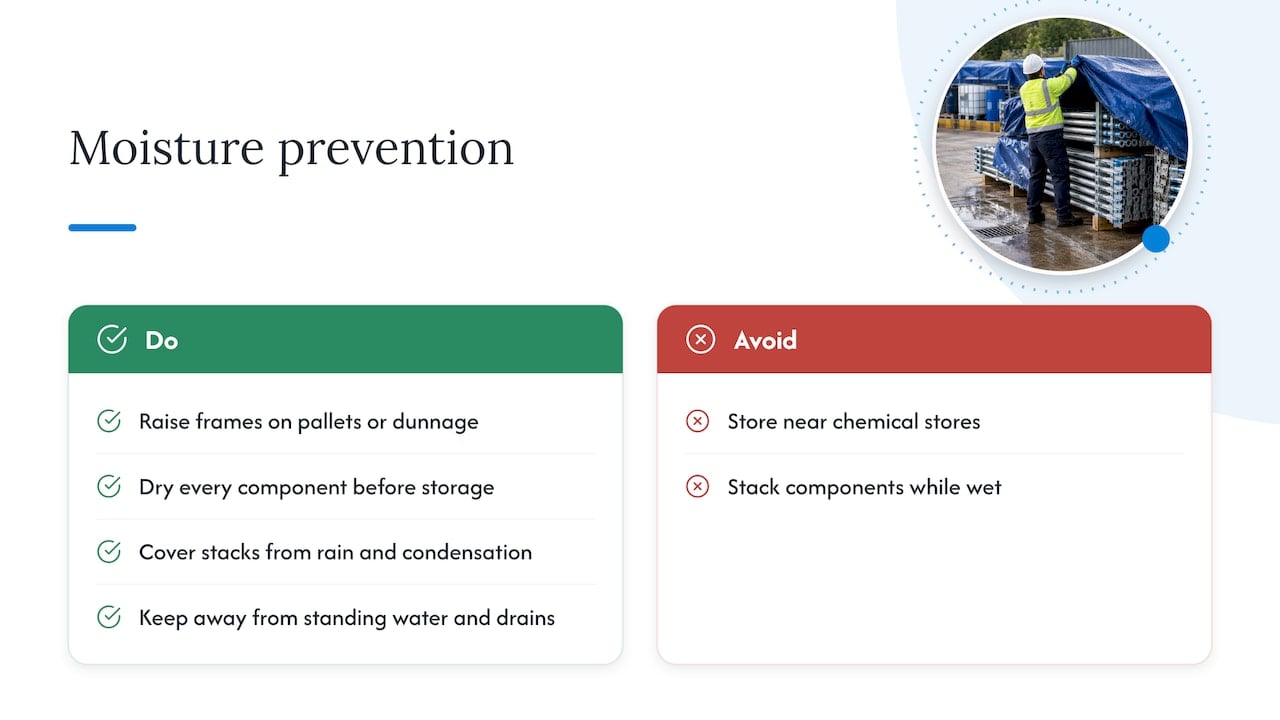
For steel fittings exposed over long storage periods, a light corrosion inhibitor can help, provided it is compatible with your manufacturer’s own guidance for the equipment. Covering stacked components, with a tarpaulin or under a proper roof, prevents rain and condensation reaching joints and castor bearings, which are the parts most likely to seize if left damp.
Avoid storing towers anywhere near standing water, open drains or chemical stores. Corrosive fumes and splashes do more damage over months of storage than most people expect, and they tend to attack exactly the small moving parts, hooks, pins and castor threads, that a pre-use inspection depends on working properly.
Author perspective: the mistakes that keep showing up
The same errors recur: towers stored wet, stacks left unbanded, nobody keeping a written inventory. None of it takes long to fix properly. Get trained or use a competent inspector, keep simple records, and treat storage as part of the job, not an afterthought.
— Dervish
How we can help with hire instead of storage
If storing a tower safely sounds like more hassle than the job warrants, hiring it instead removes the problem completely. We offer 3T Industrial Scaffold Tower Hire, Stairwell Towers hire for stairwell access jobs, and Trade Folding Tower Hire for quick, compact jobs, all with no-deposit terms and free next-day delivery across our London coverage area.
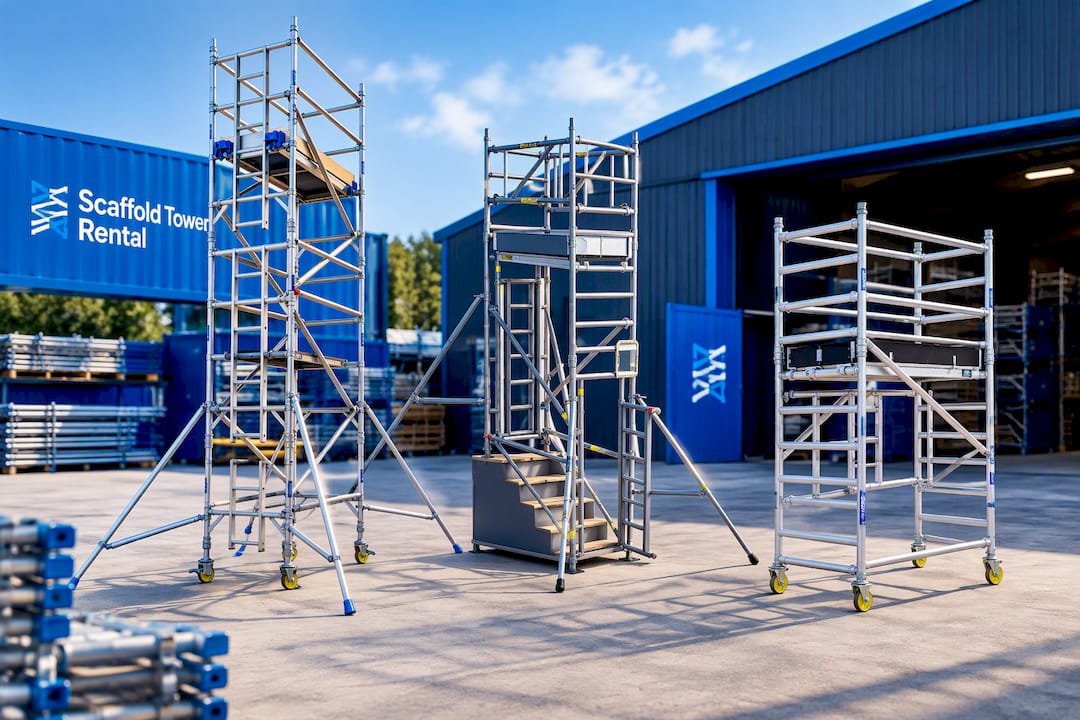
Every tower leaves us compliant with UK safety standards and ready for immediate use, so you can skip the cleaning, racking and inspection cycle between jobs. Browse the full range in our shop or get in touch for advice on which configuration suits your job.
FAQ
How tall can you build a scaffold tower?
The permitted height depends entirely on the manufacturer’s instructions for that specific tower, which set the maximum configuration for the base size and stabilisers used. There is no single universal height limit, so always check the manual supplied with the tower rather than assuming a figure.
What are the three types of scaffolds?
Scaffolding is commonly grouped into supported scaffolds, which stand on the ground or a structure, suspended scaffolds, which hang from above, and aerial lifts or mobile towers, which move on wheels or are relocated between positions. Mobile access towers, the type most relevant to this storage guide, fall into the supported category when assembled and are designed to be moved at reduced height.
How long can scaffolding be left up?
There is no fixed universal time limit, but any scaffold or tower left standing for an extended period needs periodic inspection to confirm it remains safe, with records kept each time. HSE guidance ties safe duration to ongoing inspection rather than a calendar cut-off.
What is the 3 to 1 rule in scaffolding?
The rule generally refers to the base-to-height ratio used to judge when a tower needs stabilisers or outriggers, broadly meaning height should not exceed roughly three times the smallest base dimension without extra support. Definitions vary between manufacturers, so the specific ratio and stabiliser requirements for your tower are set out in its own instruction manual.
What should I check before storing scaffold tower components?
Clean every component to remove concrete and corrosive residue, dry it fully, then inspect for dents, damaged hooks and seized castors before stacking anything away. Keep a written record of the check and quarantine anything damaged rather than storing it with usable stock.