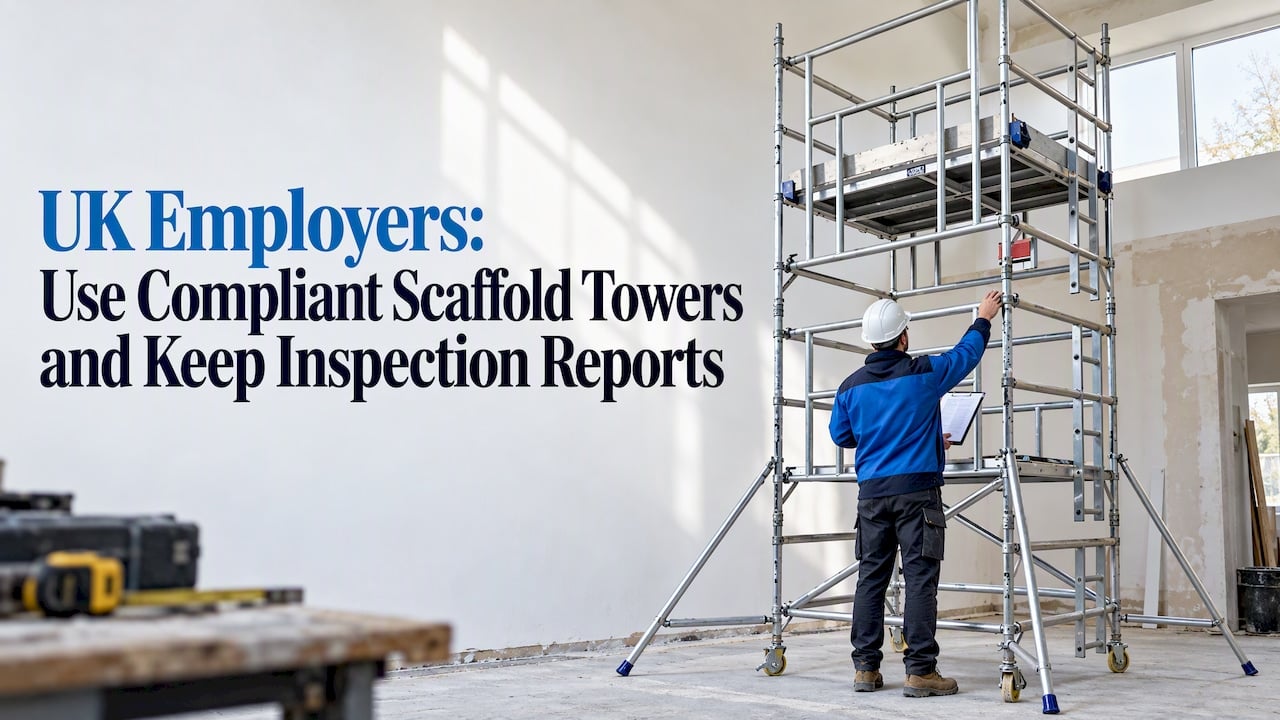
Under the Work at Height Regulations 2005, employers and anyone who controls work must plan, supervise and use competent people and equipment, following the avoid, prevent, minimise hierarchy. The rules apply wherever a fall could cause injury, with no statutory minimum height, and HSE guidance sets out what counts as reasonable compliance for most workplaces.
TL;DR:
- Regulation 12 requires competent inspections before first use, every seven days for construction platforms with fall risks over 2 meters, and after safety incidents.
- Formal inspection reports are due within 24 hours and stay on site through completion, then three months; daily user checks do not replace them.
- A rescue plan must identify who raises the alarm, available trained rescuers, and recovery equipment; relying only on calling the fire and rescue service is insufficient.
- Guardrails and fully boarded platforms take priority over harnesses; construction platform guardrails must reach 950 millimeters, with intermediate gaps no wider than 470 millimeters.
- Use ladders only for straightforward, brief, low risk tasks; select towers or powered platforms based on the surface, overhead hazards, and rescue needs.
Table of Contents
- What counts as working at height under the regulations
- Who holds responsibility and what duties they must meet
- Choosing the right equipment: collective protection first
- Risk assessment, inspection and record-keeping requirements
- Competence, training and planning for rescue
- A practical checklist for site supervisors
- What hiring scaffold towers teaches us about compliance gaps
- How our scaffold tower hire supports your compliance
- FAQ
- Sources
What counts as working at height under the regulations
The Work at Height Regulations 2005 cover employers, the self-employed and anyone who controls how work at height is carried out, including facilities managers and building owners. They apply wherever a person could fall a distance liable to cause personal injury, whether that is from a ladder, a flat roof, a fragile surface or through a floor opening.
There is no fixed minimum height in law. HSE expects particular attention for work involving falls from heights considered to be significant, but there is no fixed legal minimum height; the real test is always the risk of the task itself.
Common situations that fall within scope include:
- Working from ladders, stepladders or mobile towers at any height
- Accessing flat or pitched roofs, including fragile roof lights or sheeting
- Working near unprotected edges, floor openings or stairwells
- Using podium steps or platforms above ground level, however briefly
Who holds responsibility and what duties they must meet
Responsibility sits with whoever controls the work, not just the person doing it. On a construction site this often means the principal contractor, the client and individual employers all carry duties at once, so coordination matters as much as the risk assessment itself.
Key duties include:
- Ensuring work is properly planned, appropriately supervised and carried out by competent people
- Selecting work equipment suited to the task, the surface and the duration involved
- Keeping evidence of competence, such as training certificates and toolbox talk records
- Making sure workers co-operate with safe systems and report defects promptly
Where several contractors share a site, written coordination, such as a simple method statement exchange, avoids duplicated or conflicting instructions.
Pro Tip: Keep training certificates and inspection records in one folder per project, so you can produce evidence instantly if HSE or a client asks for it.

Choosing the right equipment: collective protection first
Regulation 6 sets out the control sequence that should shape every equipment decision: avoid work at height where reasonably practicable, prevent falls with suitable equipment where it cannot be avoided, and minimise fall distance and consequences where residual risk remains. Collective protection, such as guardrails and fully boarded platforms, must take priority over personal protection like harnesses, because it protects everyone on the platform without relying on individual action.
In practice, the choice between a ladder, a scaffold tower or a mobile elevating work platform depends on the task, its duration and frequency, the surface underfoot, overhead hazards and how a casualty would be rescued if something went wrong. Ladders remain acceptable for short, low-risk jobs, but HSE guidance is clear that they are a last resort for straightforward, short-duration work rather than a default choice.
Before hiring or assembling equipment, check:
- Guardrail height meets 950 millimetres for construction platforms, with intermediate gaps no greater than 470 millimetres
- Platforms are fully boarded with no gaps that could drop tools or materials
- The tower has been assembled following PASMA or TG20 guidance for scaffold towers
Risk assessment, inspection and record-keeping requirements
Planning is a legal duty, not paperwork for its own sake. A risk assessment for height work must weigh the height involved, how often and for how long the task is repeated, the condition of the surface, any fragile areas, the risk of falling objects, and how someone would be rescued if they fell or became stranded.
Regulation 12 adds specific inspection duties for working platforms:
- Inspect the platform after it is assembled or installed, before first use
- Re-inspect every seven days while a construction platform remains on site where a fall of more than 2 metres is possible
- Carry out an additional inspection after any event likely to have affected its safety, such as high winds or an impact
- Prepare a written inspection report and provide it within 24 hours of the inspection
- Retain that report on site until the work is completed, then for three months afterwards
A daily pre-use check by the user is not the same as this formal inspection, which must be carried out and signed off by a competent person. Report particulars, including the equipment, location, date and inspector’s identity, follow Schedule 7 of the Regulations. Where a tower is simply moved around the same site rather than dismantled, a fresh seven-day report is not triggered, though reassembly does require a new pre-use inspection.
Competence, training and planning for rescue
Competence is judged on training, experience and the ability to spot problems, not just a certificate on file. For towers and scaffolds, recognised schemes such as PASMA for mobile towers and CISRS for scaffolding are widely referenced by HSE as evidence of appropriate training, and the same logic applies to supervision of ladder work and mobile elevating work platforms.
Rescue planning is where many sites fall short. Regulation 4 requires that planning includes emergencies, and HSE guidance is explicit that a rescue plan cannot rely solely on calling the fire and rescue service. You need to know in advance how an incapacitated person would be recovered, who raises the alarm, and what rescue equipment and trained people are available on site.
- Confirm who on site is trained to operate rescue equipment before work starts
- Run a brief rescue drill for unfamiliar equipment or new site layouts
- Record who holds current PASMA or CISRS training for the equipment in use
Pro Tip: Ask every operative to confirm, before the first lift or climb, exactly who would raise the alarm and how a casualty would be brought down safely.
A practical checklist for site supervisors
Turning the regulations into daily practice does not need to be complicated. The table below sets out the priority actions and when to complete them.
| Stage | Action | Why it matters |
|---|---|---|
| Before work starts | Complete a task-specific risk assessment | Confirms height, duration, surface and rescue needs |
| Equipment selection | Choose collective protection over harnesses where practicable | Protects the whole team, not just one person |
| On delivery | Request the inspection report for hired towers | Confirms assembly and condition before first use |
| Daily | Log a pre-use check separate from the formal inspection | Catches damage or wear between formal inspections |
| Every 7 days | Arrange a formal inspection for platforms over 2 metres | Required by regulation 12 for construction platforms |
| Before starting | Confirm rescue arrangements and trained personnel | Avoids relying solely on the fire and rescue service |
- Review the task and rule out working at height wherever an alternative exists
- Select equipment that offers collective protection suited to the task and surface
- Confirm training records and inspection paperwork before anyone climbs
What hiring scaffold towers teaches us about compliance gaps
The recurring failures we see are rarely about bad intentions. Missing inspection paperwork, towers assembled without following the manufacturer’s sequence, and rescue plans that amount to “call 999” are the three gaps that come up again and again on otherwise well-run sites.
Pro Tip: Before first use, check the tower’s base plates are level, the guardrails are locked, and the inspection tag matches the report you were given.
— Dervish
How our scaffold tower hire supports your compliance
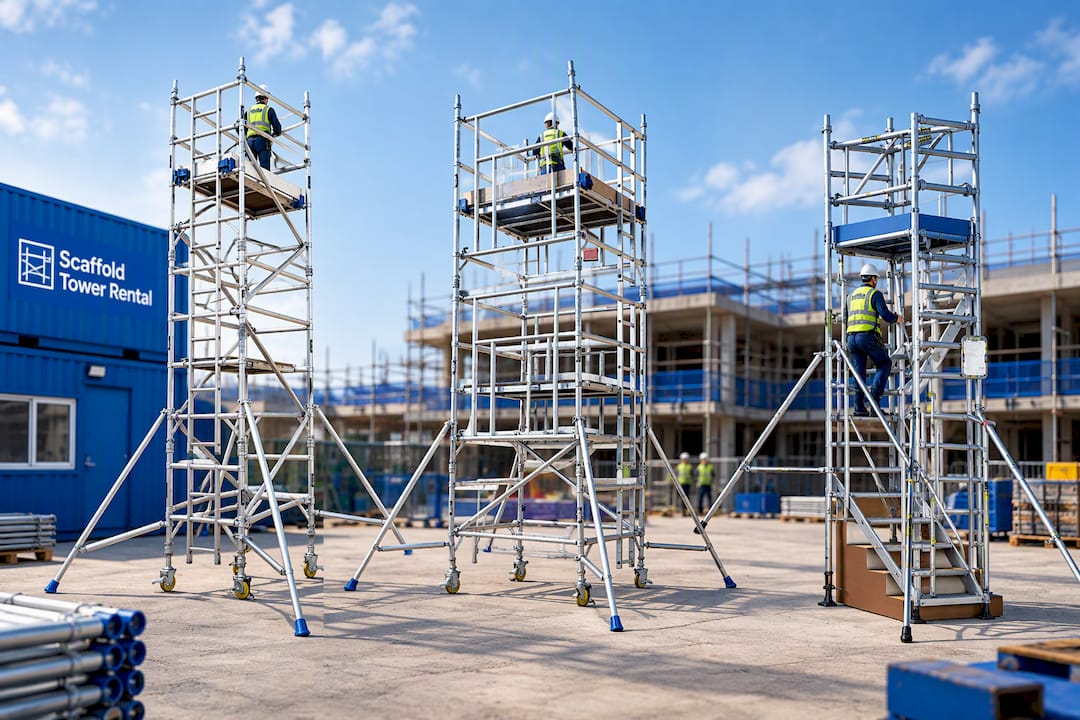
Meeting the Regulations is easier when the equipment arrives already compliant. Our 3T Industrial Scaffold Tower Hire and AGR Scaffold Tower Hire (Advanced Guardrail) come fitted with guardrails and non-slip platforms, and our Stairwell Towers are built for confined stairwell access where a standard tower will not fit.
- Every tower arrives with the current inspection record for your project file
- Fast delivery options aim to get compliant equipment on site promptly
- No-deposit hire across our full range means you are not tying up cash to stay compliant
Work through our scaffold tower hire checklist before you book, then get a quote for the tower that matches your task.
FAQ
What are the HSE guidelines for working at height?
HSE’s brief guide INDG401 sets out a three-step approach: avoid work at height where possible, prevent falls with suitable equipment, and minimise the distance and consequences of a fall where risk remains. Following this guidance is normally enough to meet the legal duties under the Work at Height Regulations 2005.
What is the maximum height you can work without safety?
There is no maximum or minimum height written into the Work at Height Regulations 2005; they apply wherever a fall could cause injury. HSE treats falls of more than 2 metres as an enforcement priority, but the actual legal duty to plan and protect applies regardless of the exact height.
What is not classed as working at height?
Walking on a permanent, solid surface such as a normal staircase with existing handrails is generally not classed as working at height under the Regulations. The test is whether a person could fall a distance liable to cause personal injury, not the activity’s label.
Is it an employee’s responsibility to avoid working at height?
The main legal duties fall on employers and those who control the work, who must plan, supervise and provide suitable equipment. Workers still have a duty to co-operate with safe systems, use equipment correctly and report any defects they notice.