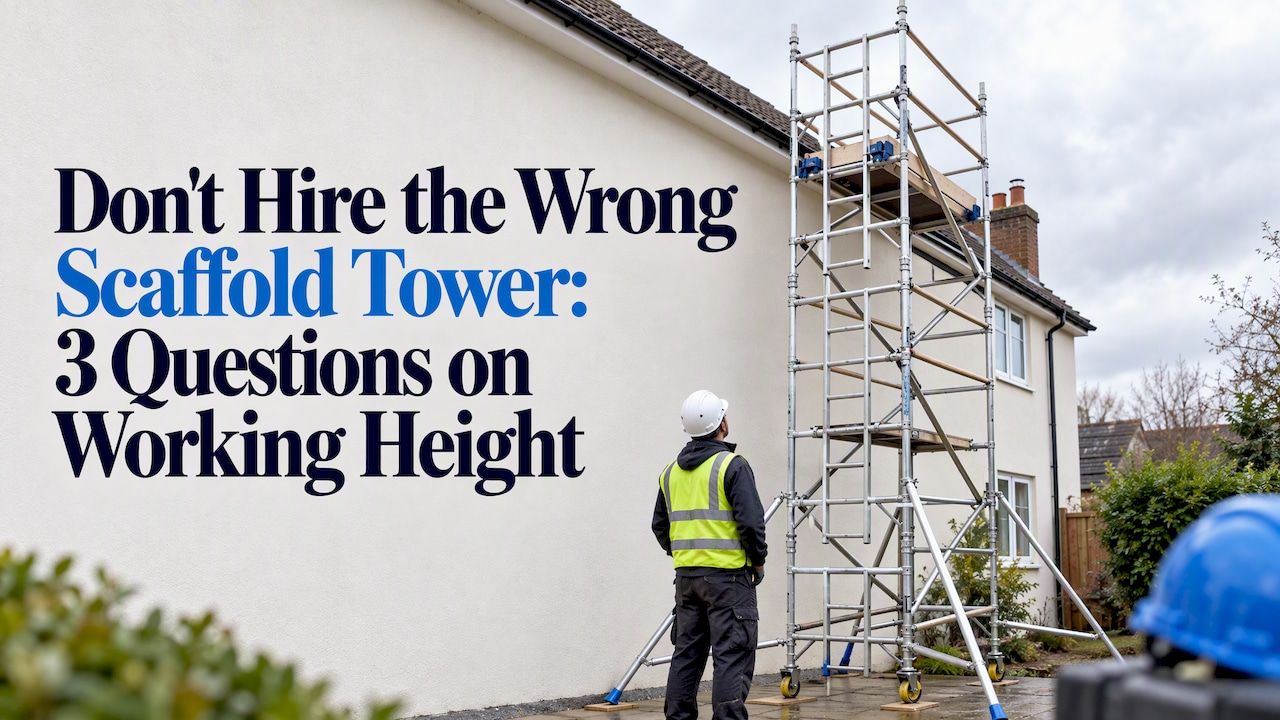
Working height means the maximum reach a person standing on the platform can safely achieve, calculated as platform height plus roughly 2 metres for an average worker’s arm reach. For standard mobile towers covered by EN 1004-1:2020, platform heights typically run up to around 8 metres outdoors and 12 metres indoors according to the standard’s practical scope, but there is no single statutory height cap. The deciding factors are the manufacturer’s instructions, ground conditions, stabilisation, and wind.
TL;DR:
- Most mobile towers built to EN 1004-1:2020 typically reach up to 8 meters outdoors and 12 meters indoors, but actual safe working height depends on ground and wind conditions.
- Manufacturer instructions and site specifics, such as ground firmness and wind speed, determine the need for stabilisers, outriggers, or ties at any given height.
- The 3:1 and 4:1 height-to-base ratios are guides, not legal limits; stabilisation requirements are set by the tower’s configuration and manufacturer guidance.
- Assembly and dismantling should always follow safety procedures, including guardrail installation, working from guarded platforms, and supervision by competent persons.
- Hiring decisions should consider the exact working height required, site environment, and stabilisation needs; always verify platform maximums and stabiliser instructions.
Table of Contents
- Platform height versus working height: how to calculate what you need
- Standards and practical maximums: EN 1004 and PASMA notes
- Legal duties in the UK: the Work at Height Regulations 2005 in practice
- Stabilisers, outriggers and the 3:1/4:1 rules: separating myth from requirement
- Assembly, dismantling and safe working practice
- Wind, ground and site geometry
- When a scaffold tower is the wrong tool
- Publisher perspective: how our hire checks and fleet address these issues
- How to hire: what to ask when booking
- FAQ
- Sources
Platform height versus working height: how to calculate what you need
Platform height is the distance from the ground to the floor of the working deck. Working height is a practical convention: platform height plus roughly 2 metres to represent the reach of a standing adult, though manufacturer conventions for this calculation vary and some suppliers state working height explicitly rather than leaving you to add the margin yourself.
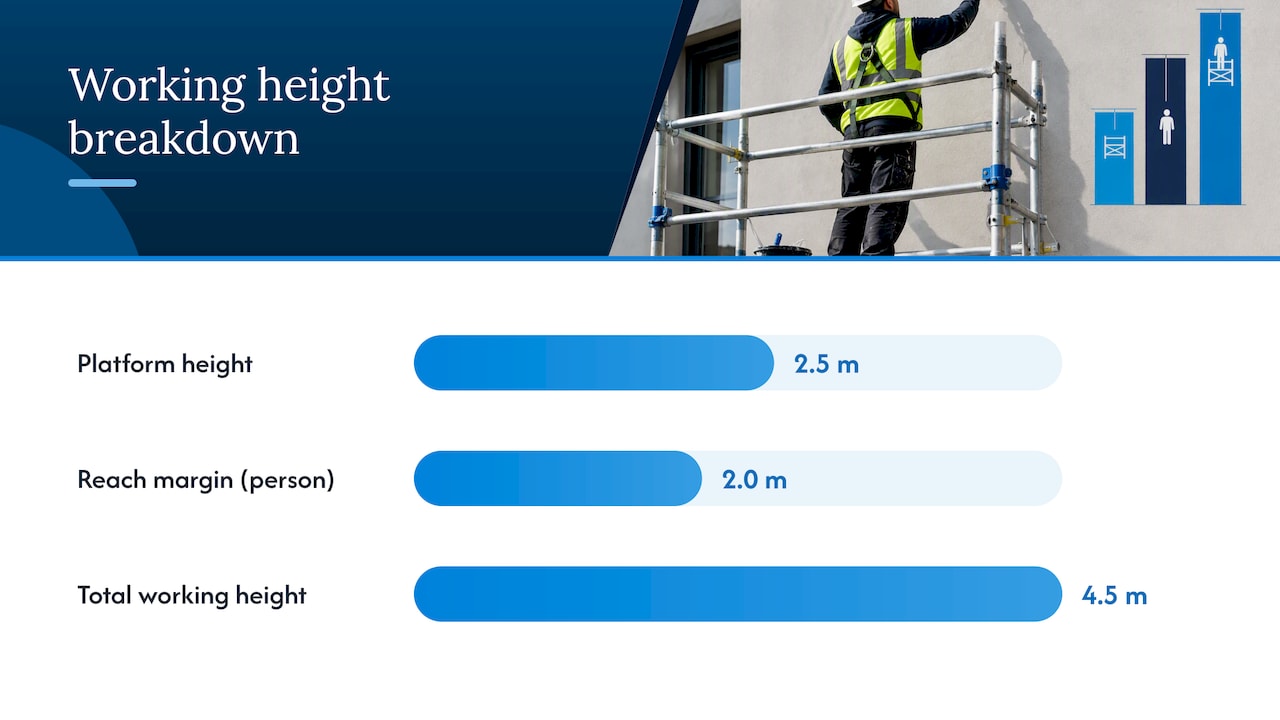
If you need to reach a ceiling at 4.5 metres to paint it, a platform height of around 2.5 metres generally provides sufficient working height once you account for arm reach and tool length. Always confirm the platform height figure separately, since it also determines whether the tower will clear doorways, stairwells, or transport routes.
Before choosing a tower, work through a short checklist:
- Confirm the finished reach you actually need for the task, not just the ceiling or gutter height.
- Add a safety margin rather than cutting the working height to the exact millimetre.
- Check for overhead obstructions such as beams, light fittings, or sloped ceilings that reduce usable platform height.
Standards and practical maximums: EN 1004 and PASMA notes
Most mobile aluminium towers sold or hired for general use are built to EN 1004-1:2020, which covers standard mobile access towers with a practical ceiling of around 8 metres platform height outdoors and 12 metres indoors. That “8/12” figure is not a legal limit, it is the scope the standard was designed around, and towers within it are intended to be moved and used without ties.
PASMA guidance also describes other tower types that sit outside EN 1004’s scope entirely, including linked, tied, and high-level configurations built to BS 1139-6. These are different products with different stability requirements, not simply taller versions of a standard tower, so a height advertised for one configuration cannot be assumed to apply to another.
Before hiring or buying, check two things:
- The product’s EN 1004 designation or equivalent standard, stated in its documentation.
- The manual’s declared maximum platform height for the specific configuration you intend to use, not a generic figure from marketing copy.
Legal duties in the UK: the Work at Height Regulations 2005 in practice
Schedule 3 of the Work at Height Regulations 2005 sets out requirements for working platforms rather than a single permitted height. Supporting surfaces must safely carry the structure, the platform, and the load placed on it, and wheeled structures must be prevented from moving while anyone is working on them.
HSE guidance on mobile work equipment places tower selection within a broader duty: assess the task and its risks, choose equipment suited to that task, and control hazards such as unstable ground, unexpected movement, and falls. Your obligations depend partly on whether you are using the tower as an employer, a self-employed tradesperson, or a domestic user.
Three points follow from this:
- Strength, stability, load capacity, and safe access must all be addressed, not just height.
- Assembly, significant alteration, or dismantling of complex configurations requires planning and competent supervision.
- There is no legal maximum height figure to look up: safety depends on the specific configuration, the ground, and the controls in place.
Stabilisers, outriggers and the 3:1/4:1 rules: separating myth from requirement
The 3:1 and 4:1 height-to-base ratios circulating online are rough guidance patterns, not a universal statutory rule that overrides the tower’s own manual. PASMA’s safety guidance confirms that stabilisation requirements are set by the manufacturer’s configuration, not a fixed ratio applied across every product.
Whether stabilisers, outriggers, or ties are required depends on the manufacturer’s stated configuration, wind exposure, the load being carried, and site conditions such as ground firmness.
- Check the manual for the exact stabiliser or outrigger configuration required at your intended height.
- Never improvise outriggers or substitute parts from a different tower model.
- Never omit a tie or stabiliser the manual specifies, even for short-duration work.
Pro Tip: Keep the tower’s instruction manual on site during use, not just during assembly, so anyone adjusting the configuration can check the current requirement.
Assembly, dismantling and safe working practice
EN 1004 towers are designed to be built and taken down safely by supplying enough platforms to install them at roughly 2 metre intervals during assembly, so you are always working from a guarded platform rather than climbing exposed frames.
Falls during assembly and dismantling are a recognised risk point that EN 1004’s platform-interval design is specifically intended to reduce.
Keep to these practices every time:
- Never climb the frame structure or stand on a deck that is not yet complete.
- Fit guardrails and toeboards before anyone uses the platform for work.
- Have assembly, modification, or dismantling carried out or supervised by someone competent for that task.
Wind, ground and site geometry
Nominal height limits assume good conditions. In practice, wind and ground conditions often force a lower safe working height than the standard allows. PASMA’s EN 1004 guidance links the standard’s scope to a wind load of around 0.1 kN per square metre, which translates roughly to a 17 mph threshold for many towers, beyond which work should stop.
Ground conditions matter just as much: firm, level support is essential, with load-spreading pads or baseplates used on soft or uneven ground, and wheels locked throughout use.
Before setting up, check:
- Current and forecast wind speed against the manufacturer’s stated limit.
- Ground firmness and slope, including the risk of settling under load.
- Clearance from overhead electrical lines and any horizontal outreach needed to complete the task.
Pro Tip: Treat wind limits as a stop-work trigger, not a judgement call: agree the cut-off speed before work starts, not while the tower is already loaded.
When a scaffold tower is the wrong tool
A standard mobile tower is not always the right choice. Podium steps suit short, low-level tasks in tight spaces, a mobile elevating work platform suits jobs needing significant horizontal outreach or heavy loads, and a tied scaffold suits prolonged work at height or exposed, windy sites.
Work through this before booking:
- Required vertical reach and any horizontal outreach beyond the platform edge.
- Load to be carried, including tools and materials, not just your own weight.
- Site access, ground conditions, wind exposure, and expected duration of the job.
When you do hire a tower, ask for the exact platform height, the working envelope, and any stabilisation or tie requirements in writing.
Publisher perspective: how our hire checks and fleet address these issues
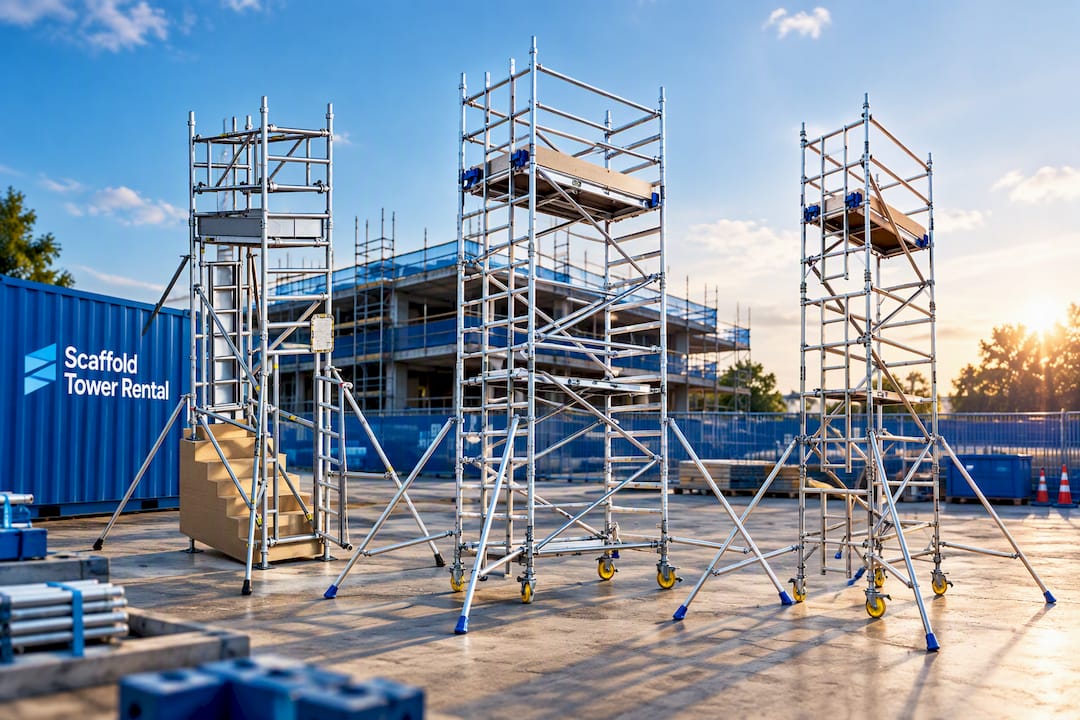
We stock towers across standard, folding, stairwell, and advanced guardrail configurations, each supplied with its manufacturer documentation so the platform height and stabilisation requirements are never a guess. On delivery, our team talks through the platform versus working height distinction for your specific model and flags whether ties, outriggers, or extra care with ground conditions apply to your job.
— Dervish
How to hire: what to ask when booking
We hold a wide range of tower sizes and types, offer no-deposit hire, and deliver locally by the next day, with every tower meeting UK safety standards before it leaves our yard. For confined stairwells or landings, our stairwell tower range gives you a narrow footprint built for that access problem specifically, while heavier trade or construction work is better served by our industrial scaffold tower hire, and jobs needing a wider working deck can step up to 3T industrial towers.
Before you book, have these answers ready so we can match the right tower to the job:
- The finished working height you need to reach, plus any overhead obstructions.
- Whether the site is indoors or outdoors, and the ground conditions at the base.
- Any requirement for stabilisers, outriggers, or restricted access such as a stairwell.
Browse the full range of towers available to hire or get in touch to confirm the right configuration for your project.
FAQ
What is the 3 to 1 rule for scaffolding height?
The 3:1 rule is an informal guidance pattern relating base width to height, not a universal legal requirement that overrides the tower manufacturer’s instructions. The actual stabilisation and height limits for any tower are set by its manufacturer’s configuration, so the manual always takes precedence over a general ratio.
What is the 4:1 rule in scaffolding?
Like the 3:1 figure, a 4:1 ratio is sometimes quoted as a rough guide to base width versus height but is not a fixed statutory standard. Safe height and stabilisation depend on the specific tower’s declared configuration rather than a single ratio applied across all products.
What are the regulations for scaffold towers in the UK?
Scaffold towers used as working platforms fall under Schedule 3 of the Work at Height Regulations 2005, which requires platforms to be strong enough, stable, and fitted with safe access, alongside HSE guidance on assessing the task and choosing suitable equipment. There is no single statutory height limit: the regulations are risk-based and depend on the equipment, site, and controls in use.
How high can scaffolding go without outriggers?
This depends entirely on the specific tower’s manufacturer instructions, since standard EN 1004 towers are designed with declared configurations that state when stabilisers or outriggers become necessary. There is no fixed height that applies across all towers without checking the manual for that model.
Sources
- The Work at Height Regulations 2005 (Schedule 3)
- PASMA — Ultimate guide to towers and low-level access
- HSE — Mobile work equipment and safety