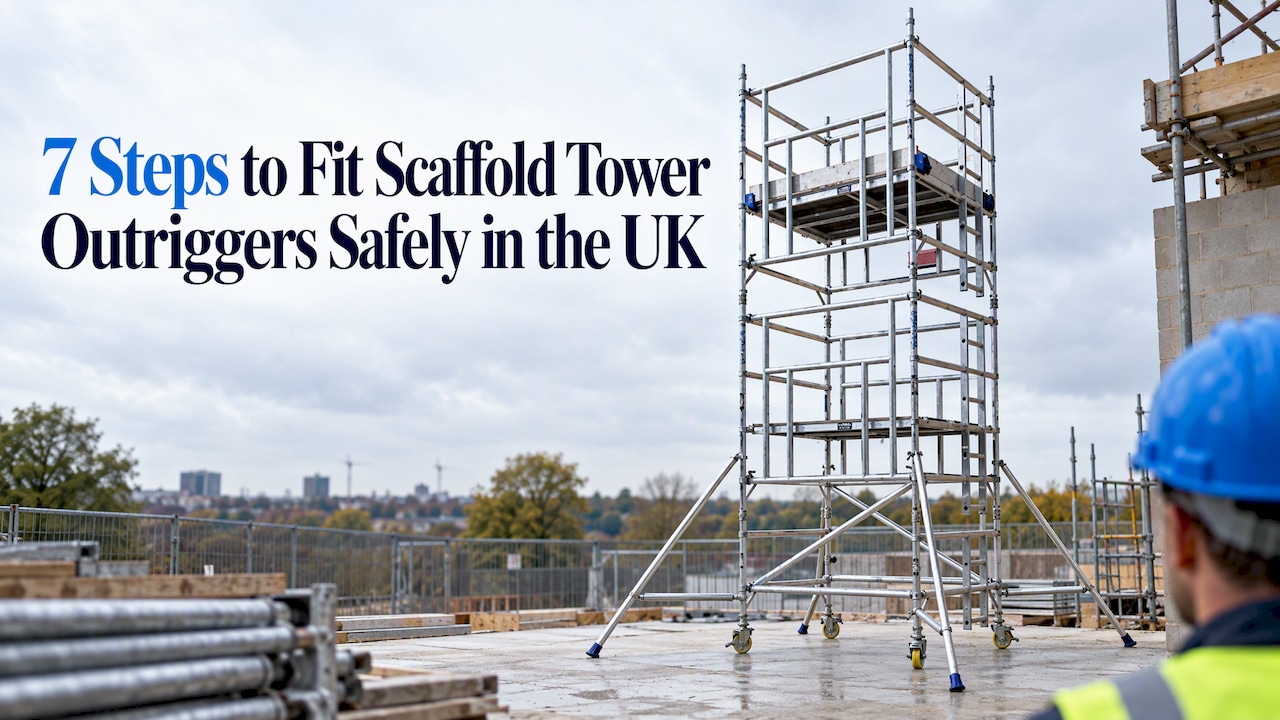
Fit outriggers whenever the tower’s instruction manual or recognised guidance calls for them, and never exceed the manufacturer’s stated height without them. HSE and PASMA set the rules that govern fitting, inspection and safe movement. The sections below cover the fitting sequence, the checks to make before use, and where to hire a tower with matched outriggers already supplied.
TL;DR:
- Outriggers are required if specified in the tower’s manual or needed when the tower is built above the manufacturer’s height limit, and they should never be used as a substitute on soft or uneven ground.
- Proper fitting involves a precise sequence: secure all clamp and pin connections, ensure each foot bears firm contact, and verify the tower is level and plumb before use or movement.
- Only use outriggers designed for your specific tower model, with matching components tested together, and avoid mixing parts from different brands or ranges.
- The ground must be firm and level, with base plates on soft surfaces, and work must stop if wind, overhead hazards, or conditions exceed safety limits.
- Regular inspections by a competent person are essential, focusing on clamps, pins, castor brakes, and component integrity, with work halted immediately upon detecting faults.
Table of Contents
- What an outrigger is and when you need one
- How to fit and position outriggers safely
- Matching outriggers to your tower
- Site and ground checks before use or movement
- Inspections, maintenance and when to stop work
- Common mistakes and how to catch them
- How hiring from Scaffold Tower Rental helps you get this right
- Practical perspective from an experienced rental provider
- Where to hire a tower with matched outriggers
- Sources
- FAQ
What an outrigger is and when you need one
An outrigger is an adjustable leg, usually fitted with a castor, that extends the footprint of a mobile scaffold tower to stop it tipping. A stabiliser does a similar job but is intended for towers that stay in one position for longer periods, while outriggers suit towers that get moved often, since they keep their castors in place throughout. PASMA’s operators’ code of practice draws this distinction clearly and recommends outriggers over stabilisers for towers in frequent use.
There is no single height at which outriggers become compulsory. Instead, HSE guidance says they must be fitted whenever the tower’s instruction manual requires them, and that a tower must never be built above the height specified by the manufacturer.
A few points decide whether you need them:
- The manufacturer’s manual states a height or configuration that requires outriggers or stabilisers.
- The tower will be moved regularly, which favours outriggers over fixed stabilisers.
- The setup falls outside standard guidance (unusual loading, ties, guys or ground anchors), which under the Work at Height Regulations 2005 and HSE’s scaffolding guidance calls for a competent person’s design and a written assembly plan rather than improvised support.
How to fit and position outriggers safely
Fitting outriggers is a sequence, not a single action, and skipping a step is usually how a tower ends up unstable.
- Build the base level first, with castors or base plates on firm, level ground.
- Fit the stabilisers or outriggers specified for that model at the earliest stage the manual allows, which PASMA recommends is as soon as the base level is complete.
- Extend each arm and secure it with its clamp and locking pin, checking that the clamp is fully closed rather than just resting in place.
- Adjust each foot until it bears firm contact with the ground; a foot that only grazes the surface gives no real support.
- Check the tower is level and plumb on two adjacent faces before adding height.
- In a corner position, reposition outriggers only after checking the adjacent wall or structure can take the load, as PASMA’s guidance sets out.
- Before use, run back through clamps, pins, level, plumb and foot contact as a final check.
Pro Tip: Walk the full base of the tower after fitting outriggers and push down on each foot in turn. A foot that moves or flexes is “floating” and needs adjusting before you climb.
Matching outriggers to your tower
Outriggers are not interchangeable between models, and assuming a bigger arm is automatically safer is a common mistake. Towers built to EN1004 are supplied with stabilisers matched to that specific frame and platform, so the components have already been tested together rather than assembled from parts that happen to fit.
A few things to check before fitting anything:
- Work from the manufacturer’s schedule of components, not a generic parts list, since arm length and clamp type vary between ranges.
- Use telescopic arms where the tower will be moved often; fixed arms suit towers that stay in one spot for longer runs of work.
- Never mix outriggers from a different model or manufacturer onto your tower, even if they appear to fit.
- Fit bracing in the positions the manual specifies; outriggers do not compensate for missing cross-braces elsewhere on the frame.
The Scaffold Tower Access Accessories page covers compatible add-ons if you need to check what pairs with a given tower before hiring or buying.
Site and ground checks before use or movement
Outriggers only work if the ground underneath them is sound. HSE guidance is specific on this point: towers need firm, level ground, with soleboards or base plates used on soft or uneven surfaces, and bricks or building blocks are never an acceptable substitute for a proper support.
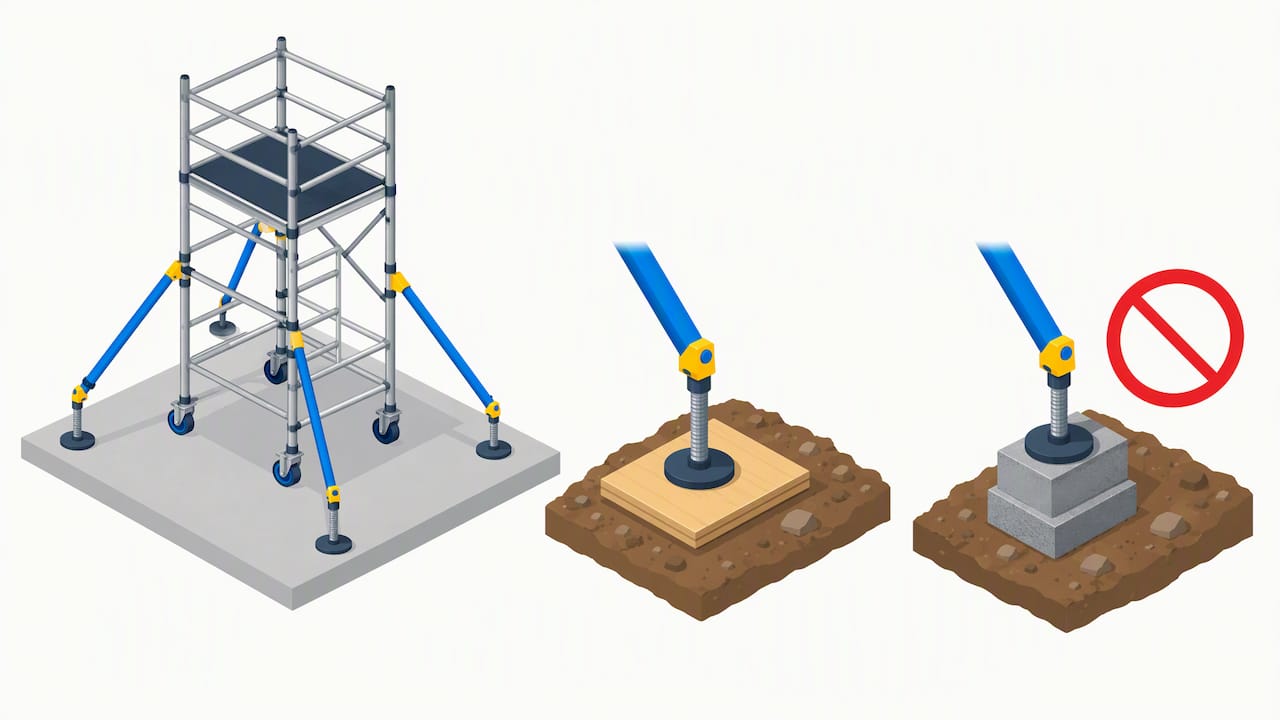
Wind and overhead hazards matter just as much as the ground. Stop work and do not move the tower if conditions exceed the limits set in the manual or PASMA’s guidance, and always check for power lines, branches or structures above before raising height.
Moving the tower safely means:
- Reduce the platform to a maximum height of 4 metres before moving, a limit HSE’s guidance sets specifically for manual movement of mobile towers.
- Clear the path of overhead obstructions and check the ground ahead is firm and level.
- Push from the base using manual effort only, then re-lock the castors and recheck that all feet, including outriggers, are back in firm contact.
Inspections, maintenance and when to stop work
Stability checks do not end once the tower is up. HSE requires an inspection straight after assembly, and then at periodic intervals, for any tower where a fall of 2 metres or more is possible.
What a competent person checks each time:
- Clamps and locking pins on every outrigger arm, confirming nothing has worked loose.
- Foot contact, checking for the floating-foot problem that visual checks alone can miss.
- Castor brakes, making sure they engage fully and hold under load.
- Corrosion, bent arms or worn pins on the outrigger components themselves.
If an inspection turns up a fault, stop work immediately and fix it before anyone goes back up. Keep a simple record of each inspection date and outcome, and make sure assembly, dismantling or any significant change to the tower is supervised by someone competent to judge it, in line with the Work at Height Regulations.
Common mistakes and how to catch them
Most outrigger failures trace back to a handful of repeated errors rather than anything exotic.
- Floating feet: an outrigger that looks fitted but is not bearing weight gives no real stability, so always push-test each foot.
- Asymmetrical placement: outriggers fitted unevenly on one side leave the tower weaker in exactly the direction it is most likely to tip.
- Soft or sloping ground used without soleboards, or bracing left out to save time.
- Makeshift packing, such as bricks or offcuts, used under a foot instead of the proper base plate or soleboard.
Pro Tip: Before climbing, run a 30-second check: clamps tight, pins in, all feet bearing, tower level. If any one of those fails, fix it before you fix anything else.
How hiring from Scaffold Tower Rental helps you get this right
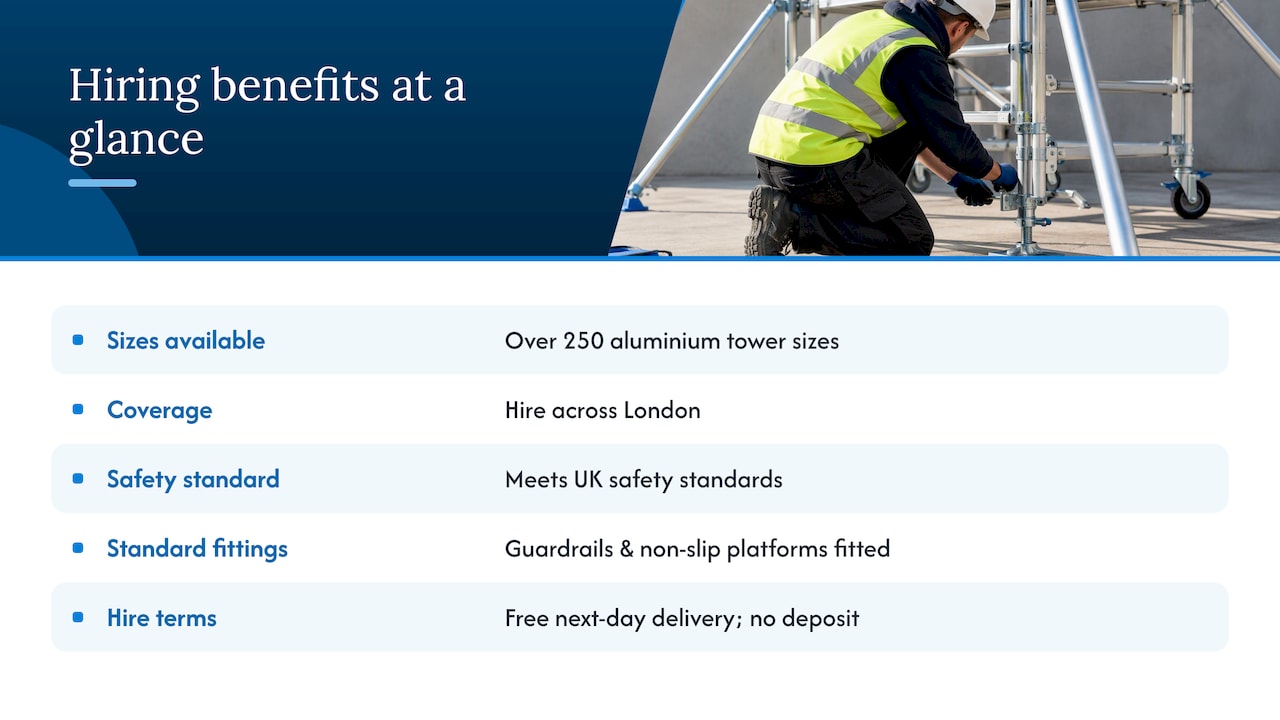
Getting outriggers right is far easier when the tower arrives with the correct components already matched to it. Scaffold Tower Rental offers scaffold tower hire across London, with a selection of over 250 aluminium tower sizes suited to painting, roofing and general construction work.
Every tower meets UK safety standards and comes with guardrails and non-slip platforms fitted as standard, so you are not left guessing which accessories a particular model needs. Hire comes with free next-day delivery and no deposit, along with personalised support to help you pick a tower that matches the job rather than one that merely looks close enough.
Practical perspective from an experienced rental provider
Most stability problems we see come down to feet that look fitted but are not actually bearing weight, and corners where someone has propped a leg on a brick rather than levelling the ground properly. If your setup does not match the manual exactly, stop and ask rather than improvise.
— Dervish
Where to hire a tower with matched outriggers
Hiring removes most of the guesswork, since the stabilisers, clamps and manual all come matched to the frame rather than assembled from whatever happens to be on hand.
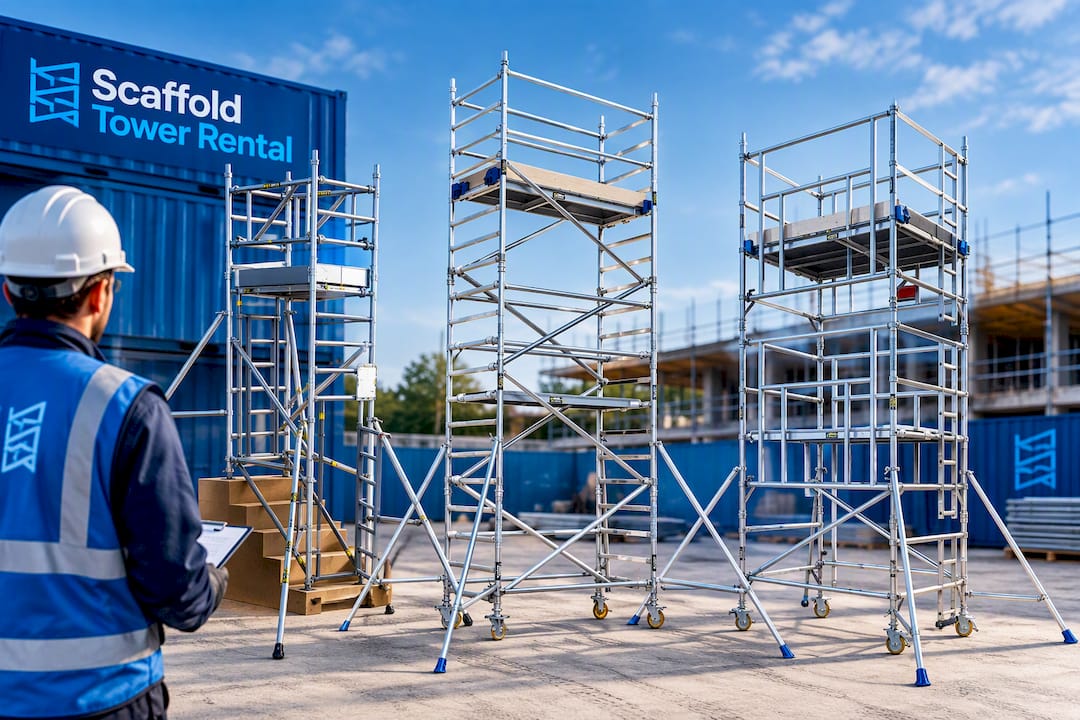
- Stairwell Towers suit staircases and tight internal access, priced between £129.99 and £149.99 per week.
- Industrial Scaffold Tower Hire covers heavier-duty jobs, priced between £79.99 and £319.99 per week.
- AGR Scaffold Tower Hire adds advanced guardrails for extra protection, priced between £119.99 and £259.99 per week.
Check the dimensions against your access space before booking, and get in touch if you want help matching a tower and its outriggers to the job. The full range, starting from £29.99 per week, is available through our shop.
Sources
For the official rules behind everything above, go straight to the source. HSE’s tower scaffold guidance and its wider scaffolding guidance cover height limits, inspection frequency and the Work at Height Regulations. PASMA’s operators’ code of practice and its page on EN1004 safety features set out fitting sequence and matched component requirements in detail.
FAQ
What are the requirements for outriggers on a scaffold tower?
Outriggers must be fitted whenever the tower’s instruction manual or recognised guidance requires them, and the tower must never be built above the manufacturer’s stated height. HSE guidance also requires firm, level ground and properly locked castors or base plates, with bricks never used as a substitute support.
How high can scaffolding go without outriggers?
There is no universal height; it depends entirely on the specific tower’s manufacturer manual. HSE confirms that height limits and outrigger requirements are model-specific, so the manual is the only reliable source for your tower.
What are the requirements for scaffolding outriggers?
Outriggers must be the type specified for that exact tower model, fitted with clamps and locking pins secured and each foot bearing firm contact with the ground. PASMA’s code of practice recommends fitting them as early as the base level is complete, with repositioning in corners only after checking the adjacent structure can take the load.
What is an outrigger on a scaffold?
An outrigger is an adjustable leg, often fitted with a castor, that extends a mobile tower’s footprint to prevent it tipping. PASMA distinguishes it from a stabiliser, which suits towers left in one position, since outriggers keep their castors usable for towers that move frequently.