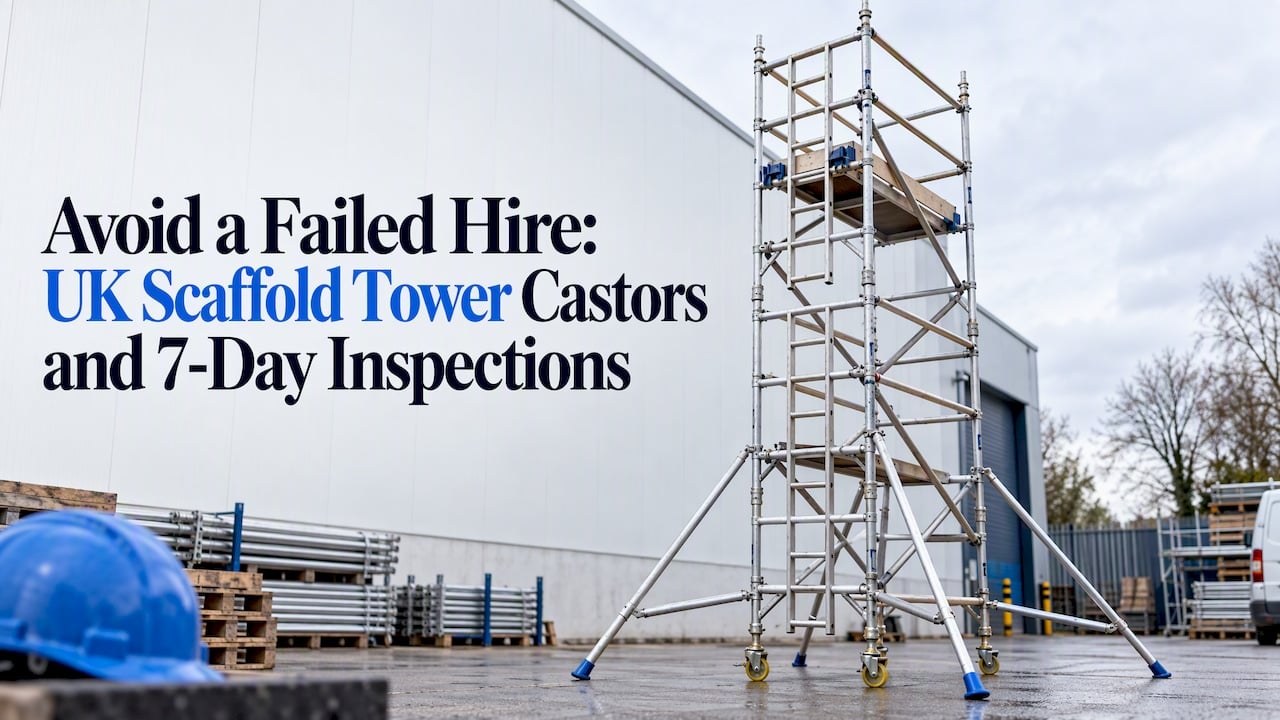
Hiring a scaffold tower on castors means renting a complete mobile aluminium tower fitted with locking wheels, not buying replacement parts. Before you book, confirm the supplier includes guardrails, toeboards, stabilisers and an instruction manual, and that the castors lock securely when the tower is in use. A competent person should inspect the structure once it is built and again at least every seven days during longer hires.
TL;DR:
- Ensure the tower can support your maximum load and fits within your access route, especially for larger or double-width models.
- Confirm the hire includes essential safety components like guardrails, toeboards, stabilisers, and suitable castors, with manuals available before delivery.
- Verify that a competent person inspects the tower after assembly and every seven days on longer hires, and keep detailed inspection records on site.
- Lock castors when the tower is stationary and only unlock them when moving the structure, checking stability and wind conditions regularly.
- Obtain all necessary licences for public ground placement before delivery, and ensure delivery components, especially castor brakes and guardrails, are thoroughly inspected on arrival.
Table of Contents
- Hiring checklist: how to pick the right mobile tower on castors
- Safety, legal and training essentials you must confirm before use
- Assembly, moving and inspection best practice for towers on castors
- Delivery and on-arrival checklist: what to inspect before signing for the hire
- What we see on real hires, and one tip worth acting on
- How we make hiring a tower on castors straightforward
- FAQ
- Sources
Hiring checklist: how to pick the right mobile tower on castors
Start with the job, not the catalogue. A platform height that clears your gutters is useless if the tower cannot carry your paint kit and a second worker.
Mobile access towers typically give a safe working platform up to around 8 metres outdoors and 12 metres indoors, according to the PASMA Operator’s Code of Practice, though this depends on the specific design and wind exposure. Match that limit, and the platform’s maximum safe working load, to the task before you book anything.
- Decide between single-width, double-width, a stairwell-access tower or a 3T industrial model, depending on how much space you have and what materials you need to carry up.
- Confirm the hire includes guardrails, toeboards, a trapdoor deck, braces, stabilisers or outriggers, and castors suited to your ground conditions.
- Ask whether the tower meets EN 1004, or BS 1139-6 for specialist configurations, and request the instruction manual before delivery.
- Check delivery and collection arrangements, including whether next-day delivery and no-deposit terms are available.
- Record the hire duration, who is responsible for any highway licence, and the damage or insurance terms in writing.
For frequent repositioning during a job, outriggers tend to work better than fixed stabilisers, per the same PASMA code, so flag this when you specify the tower.
Pro Tip: Measure your access route and doorways before booking a double-width tower; a frame that will not fit through a side gate is a wasted delivery.
Our scaffold tower hire checklist walks through inspection intervals and legal points in more detail if you want a longer reference before you commit.
Safety, legal and training essentials you must confirm before use
The legal baseline comes from the Work at Height Regulations, enforced through HSE guidance on tower scaffolds. Where a fall of two metres or more is possible, a competent person must inspect the tower after assembly and at least every seven days afterwards, and the supplier or hirer carries a duty to provide the instruction manual and the components needed for safe use.
At least every seven days, a competent person must re-inspect any mobile tower left standing where a fall of two metres or more is possible, under the Work at Height Regulations enforced by HSE. That inspection record should be kept on site, not filed away afterwards.
- Follow the manufacturer’s instruction manual exactly for assembly, bracing and height limits, as PASMA’s safety guidance requires.
- Treat PASMA’s “Towers for Users” training as close to essential if you or your team will assemble or move the tower yourselves.
- Check the tower is certified to EN 1004, or BS 1139-6 for special configurations, and ask the hirer to confirm this in writing.
- Establish early whether a highway or pavement licence applies if the tower will sit on or over public ground.
- Rely on guardrails and toeboards as the primary fall protection: inside a correctly built tower, a harness is not a substitute for them.
Highway licences are a common blind spot. Where a tower occupies the pavement or carriageway, local authorities often expect evidence of competence, such as PASMA certificates, alongside the licence application, and processing can take several weeks depending on the council. Settle this before your hire date, not on the morning of delivery.
Assembly, moving and inspection best practice for towers on castors
Most aluminium towers are built using the through-the-trapdoor method, climbing up inside the frame rather than outside it, and every step of bracing and guardrail fitting should follow the supplied instruction manual rather than memory or habit.
Before anyone climbs, check that the ground is firm and level, that all four castors are locked and in full contact with the ground, and that stabilisers or outriggers are fitted as the manual specifies.
- Confirm ground conditions and lock all castors before loading the platform.
- Fit stabilisers or outriggers exactly as the manufacturer’s manual describes.
- Unlock castors only when you are ready to move the tower, never while anyone or any materials remain on the platform.
- Push the tower rather than pulling it, and move slowly across level ground.
- Re-lock every castor the moment the tower stops, then re-check it is level before anyone climbs again.
- Log an inspection after assembly, and at least every seven days afterwards, noting any wear or damage.
When clearing a kerb or small obstruction, raise stabiliser feet by a maximum of 25 millimetres, a limit drawn from manufacturer guidance reproduced in PASMA’s instruction manual material. Adjustable legs are for levelling only: if full extension still leaves the uprights out of plumb, stop and call the supplier rather than forcing extra height.
Wind is the other variable that catches people out. Most manufacturer guidance, reflected in PASMA material, calls for work to stop once wind speeds reach around 17 miles per hour, so check the forecast before a roof-height job rather than part way through it.
Pro Tip: Keep the instruction manual on site in a waterproof sleeve. Inspectors and competent persons will ask for it, and a missing manual can hold up a job as much as a missing brace.
Delivery and on-arrival checklist: what to inspect before signing for the hire
Treat delivery as the first inspection, not a formality. Confirm the tower model matches your order and that every component is present: guardrails, platforms, braces, castors, stabilisers or outriggers, adjustable legs and the instruction manual.
- Test every castor brake individually and check each wheel for wear or cracking before accepting the delivery.
- Inspect platforms, trapdoor hinges, guardrail fittings and bracing locks for damage or looseness.
- Photograph serial or model numbers and anything that looks worn, so there is a record if a dispute arises later.
- Confirm delivery and collection dates in writing, and agree who arranges any local authority licence if the tower will sit near a public pavement.
- If you lack training or the configuration is non-standard, ask the hirer for a competent-person inspection on site before first use. A pre-use checklist along these lines, including locked castor brakes and fitted guardrails, is recommended by the British Safety Council.
What we see on real hires, and one tip worth acting on
Across repeat domestic and trade hires, the same gaps turn up again and again: a stabiliser left off the van, a manual that never made it to site, or an enthusiastic but untrained erector building a tower from memory. None of these are rare mistakes; they are the ordinary cost of treating a scaffold tower like a ladder with extra steps.
Our team works from a large catalogue of tower sizes, which helps because the fix is usually matching the right tower to the job rather than improvising with whatever arrived.
If you plan to assemble or supervise the build yourself, insist on the instruction manual and a short on-site competence check. It costs you minutes and removes most of the risk.
— Dervish
How we make hiring a tower on castors straightforward
We supply aluminium scaffold towers fitted with guardrails and non-slip platforms, with free next-day delivery and no-deposit hire available locally, so you are not tying up cash or waiting days for access equipment.
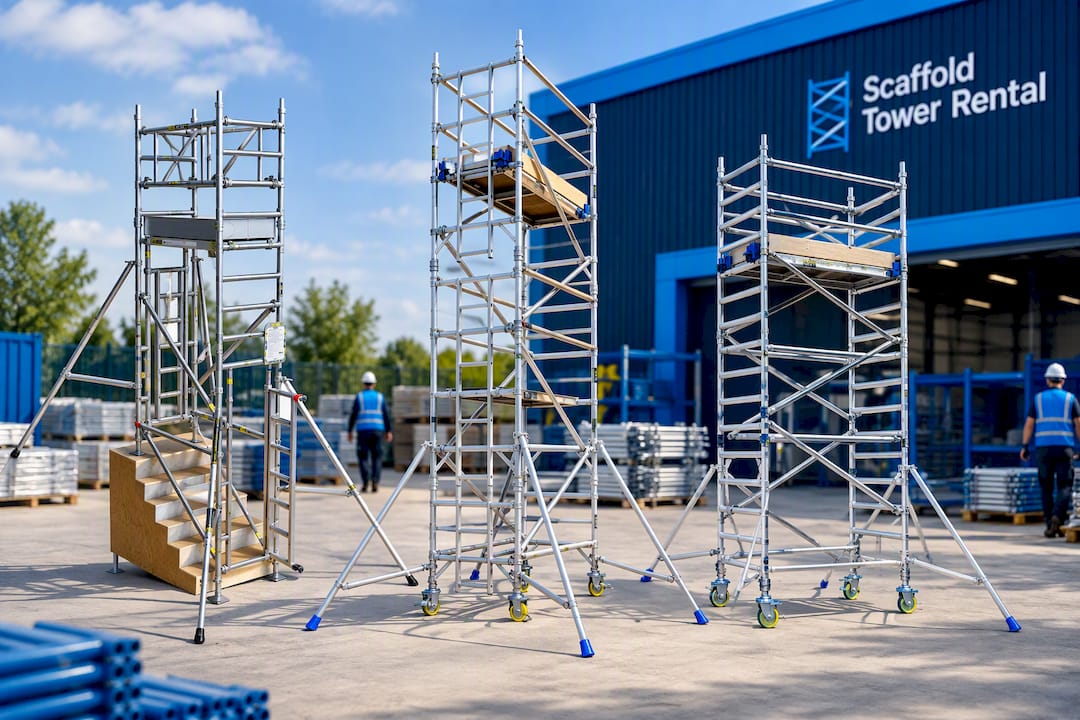
Our catalogue covers everything from Stairwell Towers for tight stair access to 3T Industrial Scaffold Tower Hire for heavier trade work, each supplied compliant and ready to use. Online booking and personalised support mean you get the right size the first time rather than guessing from a spec sheet. Browse the full scaffold tower hire range and book delivery for your next job.
FAQ
Do scaffold tower castors need to be locked at all times?
Castors should be locked whenever anyone is on the platform or the tower is stationary, and unlocked only to move it according to HSE guidance on tower scaffolds. Re-lock them the moment the tower stops and before anyone climbs back on.
How often does a scaffold tower need inspecting?
Where a fall of two metres or more is possible, a competent person must inspect the tower after assembly and at least every seven days afterwards, under the Work at Height Regulations enforced by HSE. Shorter domestic hires should still get a pre-use check at delivery.
Do I need training to assemble a mobile scaffold tower myself?
Formal competence, such as PASMA’s “Towers for Users” course, is strongly recommended and often required for site access, though rules vary by workplace. For a one-off domestic job, insisting on the instruction manual and a brief on-site check from the hirer is a practical minimum.
Is a licence needed to put a scaffold tower on the pavement?
A highway or pavement licence is usually required when a tower occupies public highway or pavement space, and local authorities often expect evidence of competence with the application. Processing can take anywhere from about a week to several weeks, so apply well before your hire date.
What does Scaffold Tower Rental include with a hired tower?
Hire includes an aluminium tower built to UK safety standards with guardrails and non-slip platforms, delivered free next-day with no deposit required. Full model and size details are listed on our scaffold tower hire page.